Ship Propulsion
System Dynamic
Simulation
Defense
ECS (Engineering Control System)
for Naval Vessels
ECS(Engineering Control System) for Naval Vessels
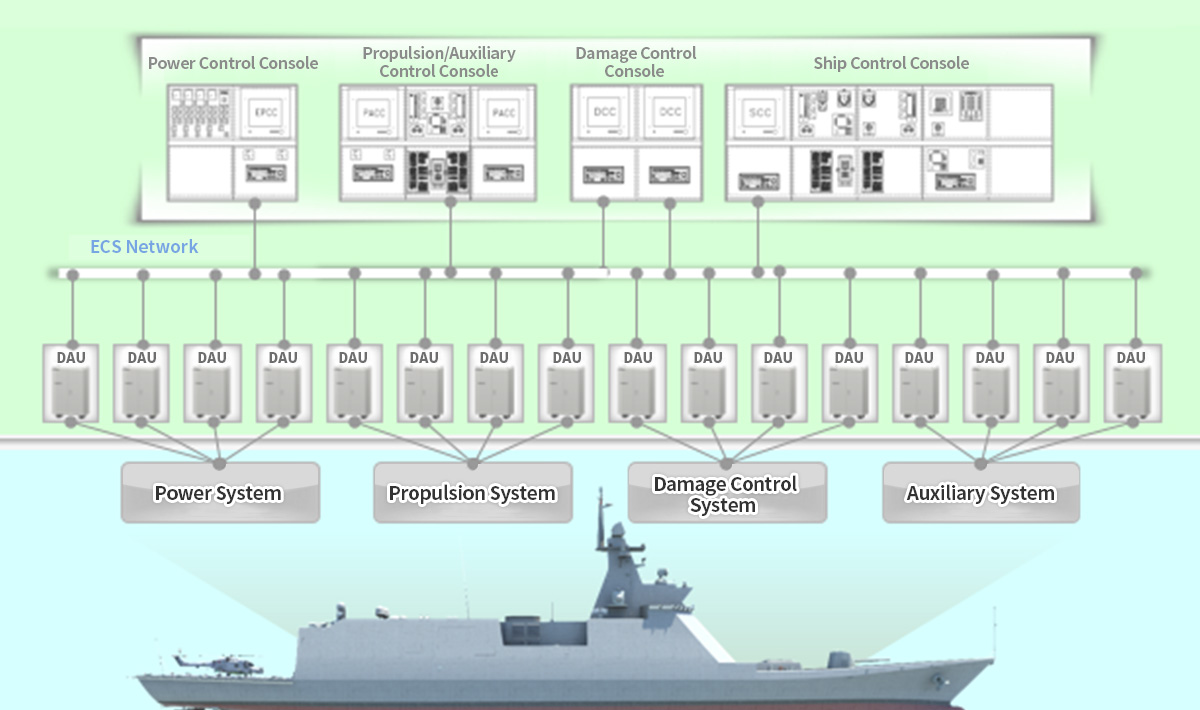
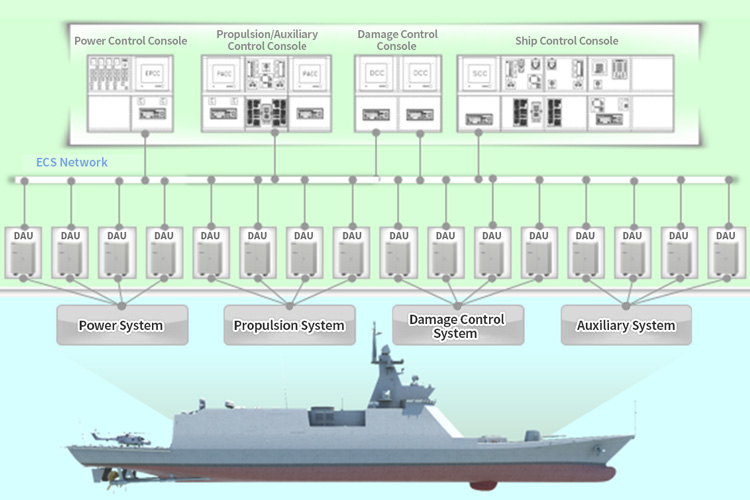
ECS provides for a network-based, integrated control and monitoring of naval vessels’ propulsion/power/damage control/auxiliary systems, which were previously controlled separately. ECS is the key device to efficiently assure naval vessels’ operability, survivability and stability.
- Features
-
- Enhances operational
efficiency, usability, and
continuity through an ergonomics-based
standardized HMI - Provides AI-enabled
condition-based maintenance
(CBM) and self-diagnostics for
improved reliability and
maintainability - Ensures interoperability with
various onboard systems,
including combat systems,
through an open architecture
framework
The Engineering Control System (ECS) is an intelligent platform that integrates core subsystems—such as propulsion, power, auxiliary machinery, and damage control—that were previously operated independently. By connecting them through a high‑speed network, ECS enables seamless real‑time monitoring and control.
ECS also serves as a core framework for smart ships, providing data‑driven precision equipment control and rapid situational response capabilities. In doing so, it ensures the vessel’s maneuverability, combat survivability, and navigational safety across multiple dimensions.
PRODUCTS
-
Ship Propulsion System Dynamic Simulation
Ship propulsion system dynamic simulation is a core engineering capability that, through precise mathematical modeling, reproduces and analyzes a vessel’s maneuvering characteristics and the physical behavior of its propulsion subsystems within a virtual environment.
By dynamically analyzing the complex interactions among propulsion engines, power systems, and steering devices, this technology enables accurate performance prediction during the design phase prior to actual ship construction. It further facilitates the early validation of control logic within the Engineering Control System (ECS), thereby substantially reducing development risks.
Moreover, dynamic analysis across varying sea states and operational scenarios supports safe navigation and ensures optimal maneuvering performance. This technology stands as a cornerstone for the future development of advanced, digitally enabled ship management and training systems.- Features
-
- Integration with HILS (Hardware‑in‑the‑Loop Simulation) for pre‑verification and optimization of ECS control algorithms
- Dynamic simulation of emergency maneuvers, including rapid acceleration, sudden stop, and sharp turning
- Time‑series and cross‑analysis of dynamic characteristics, such as ship speed, torque, output, and power consumption
-
Ship Propul-
Read more
sion Control
SWShip Propulsion Control SW
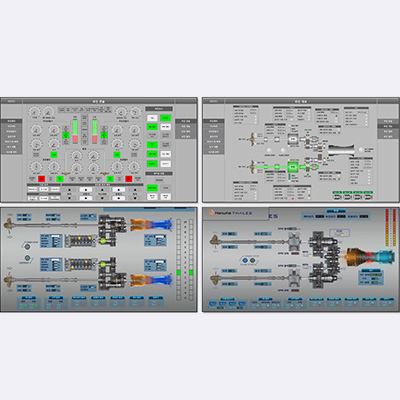
Ship propulsion control software development technology is a core capability that precisely controls the propulsion system—the vessel’s primary power source—and monitors its status in real time to achieve optimal navigation performance.
This technology goes beyond the limitations of existing systems by incorporating integrated control logic that covers not only diesel engines and gas turbines but also hybrid propulsion systems. It has been designed and developed based on an open‑standard architecture.
Furthermore, operating within a high‑reliability real‑time operating system (RTOS) environment, it ensures uninterrupted maneuverability even under extreme maritime operational conditions, serving as a pivotal component of next‑generation naval vessels.- Features
-
- High‑reliability real‑time operating system (RTOS)–based ultra‑low‑latency data processing technology
- Design and implementation of control logic for hybrid propulsion and auxiliary systems
- Modeling technology for interface device simulation to ensure reliability
-
FFX Batch-IV
Read more
Integrated
Machinery
Control SystemFFX Batch-IV Integrated Machinery Control System
This project aims to develop and localize the Engineering Control System (ECS), which provides integrated control and monitoring of propulsion, power, auxiliary and damage control systems to support mission execution of the FFX Batch‑IV.
The initiative seeks to overcome the limitations and constraints of past overseas imports, secure scalability in system integration, and ensure domestic industry support for maintenance and follow‑on logistics throughout the vessel’s entire life cycle.- Features
-
- The first government‑led system development project for the Integrated Engineering Control System (ECS) of naval vessels
- Strengthening integration with key core systems such as the Combat Management System (CMS) and the Integrated Bridge System (IBS)
-
AOE-II Combat
Read more
Support Integrated
Control System
(ECS)AOE-II Combat Support Integrated Control System (ECS)
This project involves the domestic development and deployment of the Integrated Engineering Control System (ECS) for the AOE‑II. The ECS provides integrated control and monitoring of propulsion, power, auxiliary, damage control, and onboard training systems, ensuring reliable mission execution.- Features
-
- Expansion of domestic application based on ECS test‑development technology
- Implementation of functions aligned with ROK Navy doctrines and manuals, enhancing operational usability and delivering improved software capabilities
-
DDH-I Integrated
Read more
Control System
Performance
Improvement
Program (PIP)DDH-I Integrated Control System
Performance Improvement Program (PIP)
This project aims to enhance the combat capability of the DDH‑I by improving the performance of its aging machinery monitoring and control system. To achieve this, a domestically developed Integrated Engineering Control System (ECS) will be applied, ensuring maintenance support and follow‑on logistics by domestic industry throughout the vessel’s entire life cycle.- Features
-
- The first project to apply domestically developed ECS technology to an operational naval vessel
- By adopting indigenous hardware and foundational software, the ECS can be maintained and supported entirely with domestic technology